The second WW2 book, chronologically, in my collection of Skirmish Campaign books is Norway! The book is centred on the German invasion of Norway in April 1940 and the Norwegian, British and French response.
Norway! is a 56 page, black and white, staple bound book in US letter format which includes 10 scenarios forming two campaigns.
The book starts with a single page introduction, a two page explanation of the Skirmish Campaigns format, a table detailing how to translate the scenarios to various sets of rules, a strategic map, three pages explaining the campaigns, six pages of background history and a selected bibliography before moving into the actual scenarios.
The scenarios are all around platoon size and the only armour required is a lone PzKpfw I in the base forces but addition ones, SdKfz 222 or PzKpfw IIs in the variable attachments; however, many of the scenarios require Norwegian troops, which will be difficult to source in some scales. In addition, they call for a mix of troops on both sides with the Germans requiring standard infantry, mountain troops and fallschirmjaeger; whilst the Allies require standard British infantry, Scots Guards, French Foreign Legion and Chasseurs Alpins in addition to the Norwegians (with some ski troops needed in the variable attachments).
The terrain is largely woods and hills but some scenarios require a few buildings and one needs part of the twon of Bjerkvik.
If you are interested one of the scenarios Encounter at Roa is available for download.
I have yet to play any of the scenarios from the book, largely as I don't have the suitable figures and, indeed am finding it difficult to source appropriate ones in 28mm. Of all the Skirmish Campaigns booklets I have I suspect this is the one I am likely to actually play the fewest scenarios from.
A place to share my thoughts on miniature wargaming, reviews of rules and miniatures, and comments on board and card games, RPGs (and anything else that takes my fancy!)
Saturday, 15 December 2012
Friday, 14 December 2012
WSS: Régiment de la Reine
My next French unit is the Régiment de la Reine. The regiment's origins were in the Mazarin Français Regiment, which in 1661, was named Régiment de la Reine Mère by Louis XIV as part of a general reorganisation of the French Army. Following the death of Louis' mother in 1666, the regiment was renamed the Régiment de la Reine. The regiment was part of the Marquis de Rosel's Corps at the Battle of Blenheim under the Marquis de Buzancois.
The regiment also fought alongside the Régiment de Languedoc in New France in the Seven Years War. I also have this unit in my French & Indian War collection.
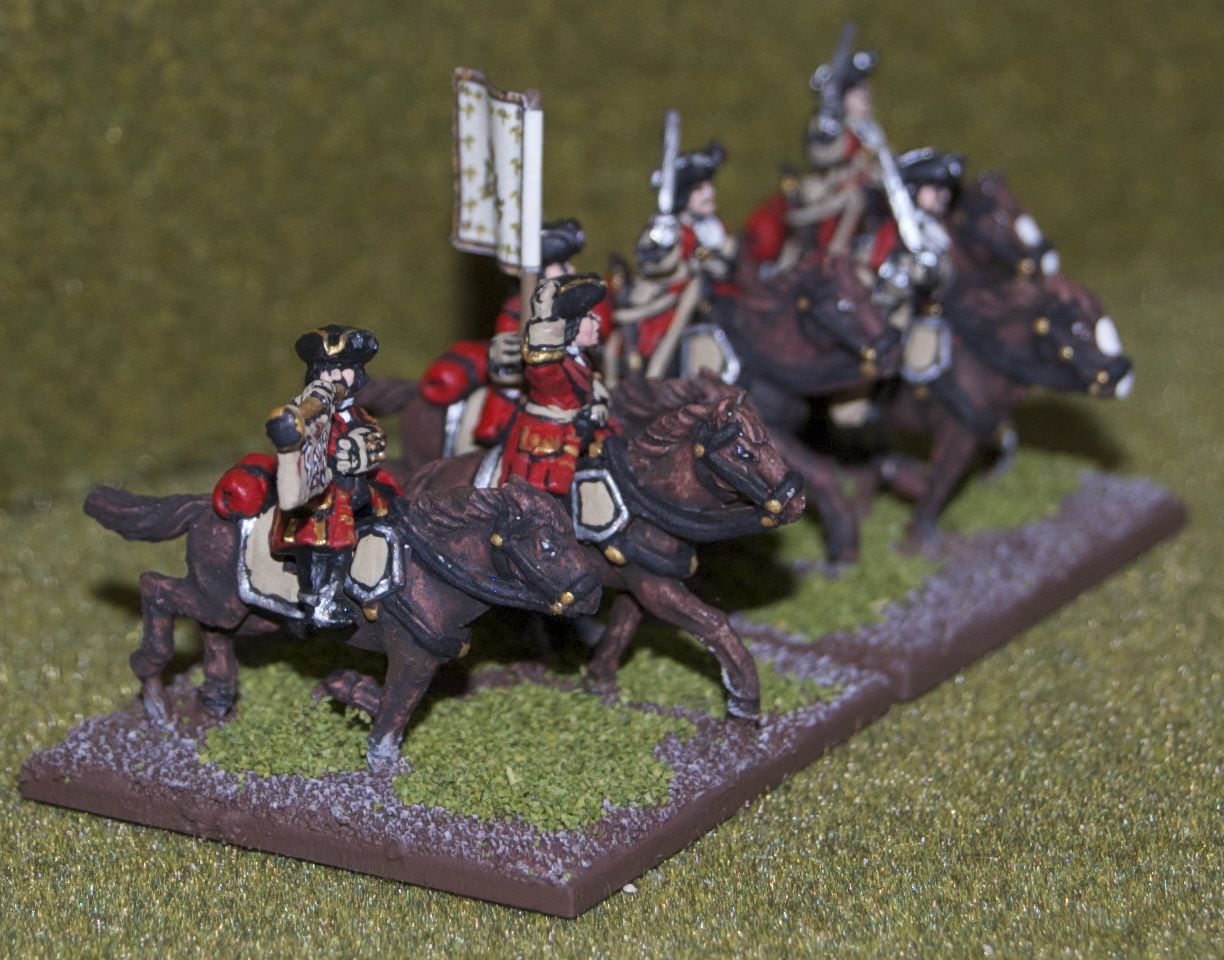
The figures are from Black Hat and the flag is from Warflag.
The regiment also fought alongside the Régiment de Languedoc in New France in the Seven Years War. I also have this unit in my French & Indian War collection.
The figures are from Black Hat and the flag is from Warflag.
Thursday, 13 December 2012
WSS: Régiment de Languedoc
The next unit for the French is the Régiment de Languedoc. The regiment was formed in 1672 by Louis XIV and recruited from the Languedoc region which gave it its name. It formed part of the Blenheim reserve in the brigade under the Baron d'Argelos.
This regiment went on to fight in New France during the Seven Years War and I have a unit to represent them in my 15mm French & Indian War collection.
As before, the figures are from Black Hat and the flag is from Warflag.
This regiment went on to fight in New France during the Seven Years War and I have a unit to represent them in my 15mm French & Indian War collection.
As before, the figures are from Black Hat and the flag is from Warflag.
Wednesday, 12 December 2012
Skirmish Campaigns: The Black Brigade
The next in my collection of Skirmish Campaign books is the first in what is their core period - World War II - it's Poland '39 - The Black Brigade. The book focuses on September 1939 and the actions involving the Polish 10th Mechanised Brigade, of the Army of Krakow, under Colonel Stanislaw Maczek in their struggle against the German invasion.
Poland '39 - The Black Brigade is a 56 page, black and white, staple bound book in US letter format which includes 10 scenarios forming four campaigns.
The book starts with a single page introduction, a two page explanation of the Skirmish Campaigns format, a table detailing how to translate the scenarios to various sets of rules, a strategic map, three pages explaining the campaigns, six pages of background history and a selected bibliography before moving into the actual scenarios.
Whilst the infantry requirements for the scenarios are all relatively small, the majority of them require armour of some sort. The Polish are mostly equipped with TKS tankettes or Vickers E light tanks and the Germans with SdKfz 222 armoured cars or PzKpfw I or II light tanks with a few motorcycles thrown in. The largest scenario calls for 4 x Pzkpfw IIc, 1 x SdKfz 221, 3 x Vickers E and 3 x TKS (2 with MGs and 1 with a 20mm cannon) along with assorted other vehicles. With regard to terrain, most of the scenarios are pretty straightforward with not too much requirement for buildings, just light woods, hills and some fields.
I have yet to play any of the scenarios from the book, but will be able to once my Polish figures are painted; however, that will be using a little poetic licence as my figures aren't right for the Black Brigade (who wore the German 1916 pattern helmet and black leather coats - hence the unit's nickname). A small range of suitable 28mm figures are now available through Gorgon Studios. Clearly some of the scenarios, especially the larger ones, may make more sense in a smaller scale given the amount of vehicles (although a TKS doesn't actually take up much space!).
If you are interested one of the scenarios, Rabka-Mszana Road is available for download.
Poland '39 - The Black Brigade is a 56 page, black and white, staple bound book in US letter format which includes 10 scenarios forming four campaigns.
The book starts with a single page introduction, a two page explanation of the Skirmish Campaigns format, a table detailing how to translate the scenarios to various sets of rules, a strategic map, three pages explaining the campaigns, six pages of background history and a selected bibliography before moving into the actual scenarios.
Whilst the infantry requirements for the scenarios are all relatively small, the majority of them require armour of some sort. The Polish are mostly equipped with TKS tankettes or Vickers E light tanks and the Germans with SdKfz 222 armoured cars or PzKpfw I or II light tanks with a few motorcycles thrown in. The largest scenario calls for 4 x Pzkpfw IIc, 1 x SdKfz 221, 3 x Vickers E and 3 x TKS (2 with MGs and 1 with a 20mm cannon) along with assorted other vehicles. With regard to terrain, most of the scenarios are pretty straightforward with not too much requirement for buildings, just light woods, hills and some fields.
I have yet to play any of the scenarios from the book, but will be able to once my Polish figures are painted; however, that will be using a little poetic licence as my figures aren't right for the Black Brigade (who wore the German 1916 pattern helmet and black leather coats - hence the unit's nickname). A small range of suitable 28mm figures are now available through Gorgon Studios. Clearly some of the scenarios, especially the larger ones, may make more sense in a smaller scale given the amount of vehicles (although a TKS doesn't actually take up much space!).
Picture from www.wwiivehicles.com
If you are interested one of the scenarios, Rabka-Mszana Road is available for download.
Tuesday, 11 December 2012
WSS: Régiment d'Artois
The second unit for my French forces is the Regiment d'Artois. The regiment was initially created in 1610 by the Comte de Beaumont Saint-Vallier. In 1670 became part of the Régiment Royal then a year letter was renamed to Régiment Chateauneuf and, finally in 1673, it took the name of the province of Artois. The Regiment was part of the Blenheim garrison under the Marquis de Balincourt.
The figures are from Black Hat and the flag is from Warflag.
Monday, 10 December 2012
WSS: Régiment d'Aunis
Having completed the first phase of my Alliance troops, I moved onto the French and here is the first unit, the Régiment d'Aunis. Created in September 1684 the regiment fought at the Battle of Blenheim in the Marquis de Montroux's Brigade.
The figures are from Black Hat and the flag is from Warflag.
Sunday, 9 December 2012
Skirmish Campaigns: The Winter War
Next up in my collection of Skirmish Campaign books is Finland '39-'40 - The Winter War. No prizes for guessing what conflict this covers! Obviously having some Winter War figures I thought this book would be a good addition to my collection.
Finland '39-'40 - The Winter War is a 56 page, black and white, staple bound book in US letter format. In addition to the introductory material it contains 10 scenarios forming four campaigns set during the Winter War between Finland and the Soviet Union.
The book starts with a single page introduction, a two page explanation of the Skirmish Campaigns format, a table detailing how to translate the scenarios to various sets of rules, a strategic map, four pages explaining the campaigns, five pages of background history and a selected bibliography before moving into the actual scenarios.
All but one of the scenarios are all platoon size or less but one requires around a company of Soviets. The terrain is mostly snow, frozen marsh and quite a bit of woods; a couple require buildings and another couple trenches and two require three T26 tanks each.
I have played two of the scenarios from the book so far (albeit with some minor adaptations to suit the figures I actually had available at the time):
If you are interested one of the scenarios Defiant Confrontation is available for download.
Finland '39-'40 - The Winter War is a 56 page, black and white, staple bound book in US letter format. In addition to the introductory material it contains 10 scenarios forming four campaigns set during the Winter War between Finland and the Soviet Union.
The book starts with a single page introduction, a two page explanation of the Skirmish Campaigns format, a table detailing how to translate the scenarios to various sets of rules, a strategic map, four pages explaining the campaigns, five pages of background history and a selected bibliography before moving into the actual scenarios.
All but one of the scenarios are all platoon size or less but one requires around a company of Soviets. The terrain is mostly snow, frozen marsh and quite a bit of woods; a couple require buildings and another couple trenches and two require three T26 tanks each.
I have played two of the scenarios from the book so far (albeit with some minor adaptations to suit the figures I actually had available at the time):
- Lake Kokkojärvi (photos here)
- The Church Village (photos here)
If you are interested one of the scenarios Defiant Confrontation is available for download.
Saturday, 8 December 2012
WSS: Hay's Grey Dragoons
My second unit of Dragoons is intended to represent Lord Hay's Regiment of Dragoons also known as the Grey Dragoons and eventually the Royal Scots Greys. Originally raised in 1678 as three separate troops of Dragoons, they were regimented in 1694 as the Royal Regiment of Scots Dragoons and had become known for their grey mounts. Lord John Hay was their Colonel from 1704 until his death in 1706. They fought in all of Marlborough's famous battles.
Once again the figures are from Black Hat and the flag is from Warflag.
Friday, 7 December 2012
WSS: Conyngham's Dragoons
My first unit of dragoons is intended to represent Conyngham's Regiment of Dragoons. The Regiment was raised in 1693 in Derry by Henry Conyngham. I was unable to find much information about their colours. I was considering an Irish flag but decided to go with a generic English one which I think works.
The figures are from Black Hat and the flag is from Warflag.
Thursday, 6 December 2012
Skirmish Elite: Battles of the Borderlands
The next Skirmish Campaigns booklet I own, chronologically, is The Russo-Polish War 1919: Battle of the Borderlands and, technically speaking, it's actually a Skirmish Elite (although the difference is a little lost on me).
Battle of the Borderlands is a 48 page, black and white, staple bound book in US letter format. In addition to the introductory material it contains 8 scenarios forming three campaigns set during the Polish Soviet War of 1919-21.
The book starts with a single page introduction to the conflict, a two page history of the borderlands, a further two pages on the campaigns, a theatre of operations map, a single page explanation of the Skirmish Campaigns format, two further pages covering notes on scale and figures, attachments and victory conditions; a table detailing how to translate the scenarios to various sets of rules and a bibliography before moving into the actual scenarios.
The scenarios are all platoon size or less but a couple require Polish cavalry. The terrain is all relatively straightforward but several of the scenarios require a number of buildings (6-10, including a church) and one requires a locomotive some freight wagons, a couple of abandoned trucks and a railway station.
Unfortunately I haven't actually played any of the scenarios from this book as yet. I do have figures suitable for the Poles as you can use figures from almost any WW1 army as they fought in most of them. It's the Soviets I need to pick up some figures for and that's on the list for my Russian Civil War project.
Obviously this book has a much narrower appeal than Rommel's Route to Verdun and with only 8 scenarios (6 if you don't have figures for the Polish Cavalry) I think it's not as good value; however, there is very little material around concerning this conflict and if you are interested it may be worth a look.
Wednesday, 5 December 2012
WSS: Cadogan's Regiment of Horse
My last English cavalry unit for this phase of the project is Cadogan's Regiment of Horse. Originally raised in 1685 (the same as the previous two - something interesting must have happened that year!*) as the Duke of Shrewsbury's regiment, then Langdale's, Hamilton's Coy's, the 6th and Arran's before passing to William, 1st Earl Cadogan's command in 1703. The Regiment fought at Blenheim, Elixheim, Ramillies, Oudenarde and Malplaquet amongst others.
*Only kidding - of course I know it was the Monmouth Rebellion!
Tuesday, 4 December 2012
WSS: Lumley's Regiment of Horse
Following on from Wood's is Lumley's Regiment of Horse. Originally raised in 1685 as Sir John Lanier's Regiment and subsequently named the 2nd Queen's Regiment of Horse. Henry Lumley who had served as a Captain in the Regiment was promoted to their Colonel following the death of Sir John at the Battle of Steenkerque in 1692. Lumley was promoted to Lieutenant General in 1703 and, interestingly (to me anyway), served as Governor of Jersey from 1704 to 1722.
Monday, 3 December 2012
WSS: Wood's Regiment of Horse
The next addition to my expanding collection for the War of Spanish Succession is intended to represent part of Wood's Regiment of Horse. Originally formed in 1685 as the Earl of Plymouth's Regiment, command passed to Lieutenant General Cornelius Wood and they served at Blenheim, Ramillies, Oudenarde and Malplaquet.
As before the figures are from Black Hat and the flag is from Warflag.
Sunday, 2 December 2012
Skirmish Campaigns: Rommel's Route to Verdun
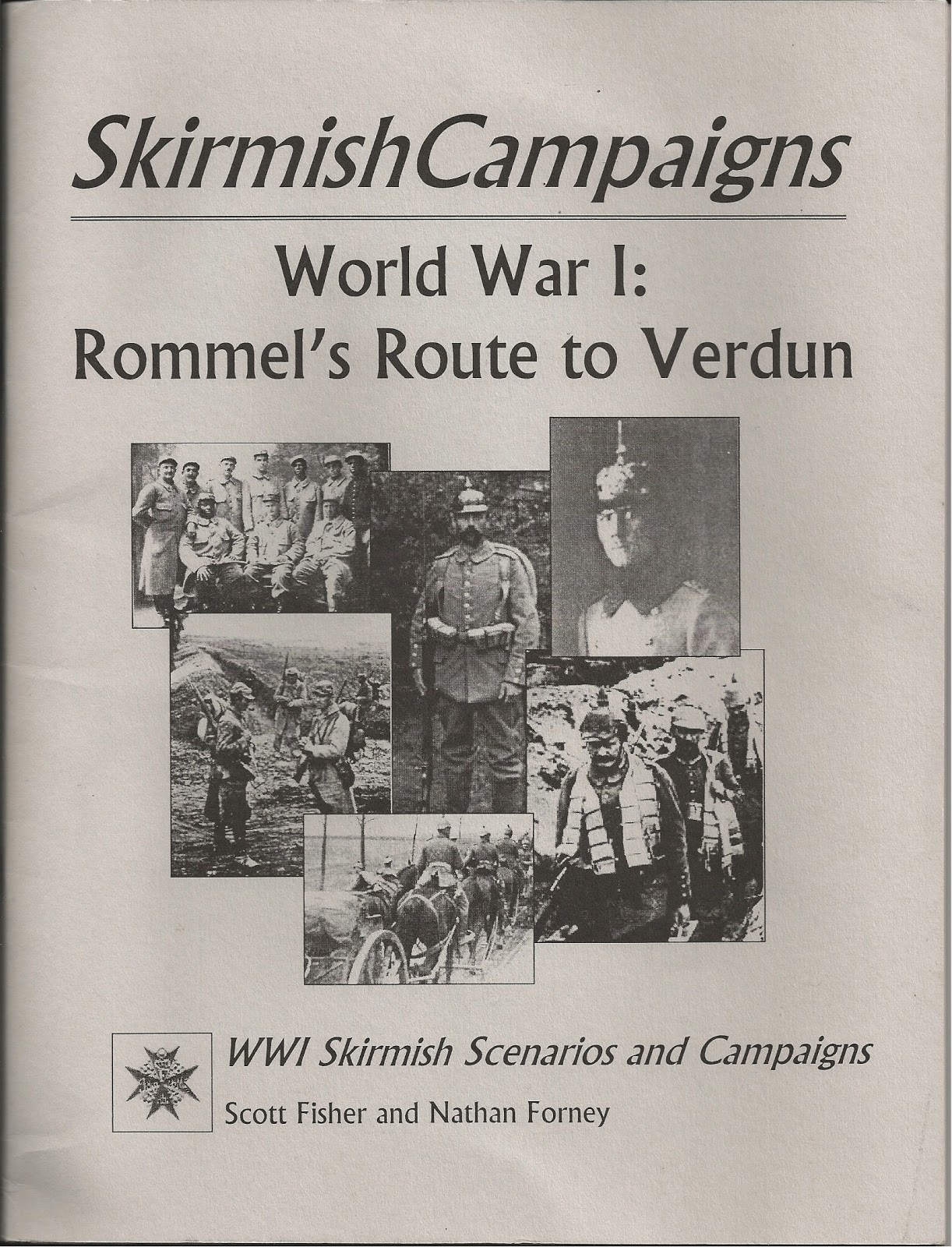
The first Skirmish Campaigns booklet I would like to cover is World War I: Rommel's Route to Verdun. This is a 60 page staple bound, black and white book covering Erwin Rommel's exploits in France in 1914.
The meat of the book is a set of 12 scenarios which can be played individually or grouped into 4 short campaigns. The scenarios themselves are all based around encounters and engagements that Rommel himself describes in his book Infantry Attacks
(originally published as Infanterie Greift An in 1937). Rommel commanded a platoon in the 7th Company, 2nd Battalion of the 124th Infantry Regiment and the scenarios revolve around a set of small engagements that he was personally involved in.
The book starts with a single page introduction, a two page explanation of the Skirmish Campaigns format, a table detailing how to translate the scenarios to various sets of rules, a strategic map, a description of Rommel the Warrior and an annotated bibliography before moving into the actual scenarios.
The scenarios are all platoon size or less and, as you might expect in 1914, none require any vehicles. The terrain is all relatively straightforward as it's mostly woods, fields and roads; however, a couple of scenarios require buildings and one, which is set in part of the town of Bleid, requires eight plus a church.
I have slowly been playing through these scenarios as you can see in the following posts:
They have all been interesting and challenging scenarios. all the more so having read Rommel's book. Obviously no everyone has the appropriate figures (although I've always thought the early WW1 uniforms are some of the most interesting) but the scenarios could easily be modified if at the expense of the historical flavour.
If you're interested in early WW1 skirmish or Rommel himself then this booklet is certainly worth a look.
The meat of the book is a set of 12 scenarios which can be played individually or grouped into 4 short campaigns. The scenarios themselves are all based around encounters and engagements that Rommel himself describes in his book Infantry Attacks
The book starts with a single page introduction, a two page explanation of the Skirmish Campaigns format, a table detailing how to translate the scenarios to various sets of rules, a strategic map, a description of Rommel the Warrior and an annotated bibliography before moving into the actual scenarios.
The scenarios are all platoon size or less and, as you might expect in 1914, none require any vehicles. The terrain is all relatively straightforward as it's mostly woods, fields and roads; however, a couple of scenarios require buildings and one, which is set in part of the town of Bleid, requires eight plus a church.
I have slowly been playing through these scenarios as you can see in the following posts:
- Recon at Cosnes (it's the fourth game in the post - the photos are here)
- Contact at Hill 325
- The Mussy-la-Ville Road
They have all been interesting and challenging scenarios. all the more so having read Rommel's book. Obviously no everyone has the appropriate figures (although I've always thought the early WW1 uniforms are some of the most interesting) but the scenarios could easily be modified if at the expense of the historical flavour.
If you're interested in early WW1 skirmish or Rommel himself then this booklet is certainly worth a look.
Skirmish Campaigns
I was just pondering ordering another of the Skirmish Campaigns scenario booklets when I suddenly realised that, apart from a couple of AARs, I have hardly mentioned them on the blog.
Whilst they publish the Arc of Fire skirmish rules and Check Your 6! air combat rules, the core of Skirmish Campaign's output is their line of scenario / campaign booklets. These are softback, US letter format and staple bound books, generally in black and white (although I think the later releases have colour covers). They are typically 50-60 pages containing around 8-10 scenarios which can often be linked into individual campaigns.
Some brief introductory material providing some context to the scenarios is provided along with a table to help translate their troop categorisation into a wide variety of rule sets - Skirmish Campaigns use Training, Morale and Leadership categories (the table is available for download from their website in MS Word format). A useful bibliography is also usually included.
Each scenario comes with an overview containing the specific setting (date, location, history, victory conditions, orders etc.), any specific scenario or campaign rules and notes and a brief outline of the historical aftermath of the scenario. This is followed by a map showing the key terrain features and entry/set up areas and finally orders of battle (OOB) for the two forces. The OOB is normally a base force along with some variable attachments which may be added based on the attachment rules and a d20 roll. The OOB for each side comes on a separate page so these can be copied and handed to the players if required (I prefer to produce my own after converting to Nuts! or I Ain't Been Shot Mum as appropriate).
I have found the booklets a great source for both pick up and play games, linked campaigns and to help generate my own scenarios. The only gripe I have is that some of the booklets have scenarios which vary wildly in the scale of the forces required and this is not usually obvious from the published information. I am planning to put up a post on each of the booklets I have and I will be including an overview of the scenario sizes which I hope will help with that.
Saturday, 1 December 2012
Liebster Award
After having a rather stressful time at work on top of feeling pretty under the weather it was nice to check back onto the blog and find that no less than three people have nominated me for the (probably now familiar to all of you) Liebster award, they are:
- Stuart of Dust, Tears and Dice
- Monty of Monty's Wargaming
- Geordie of Geordie's Big Battles
I believe (although the actual origins of the award remain shrouded in some mystery) that the purpose of the award is to help bring attention to blogs with only a few followers (under 200 has been suggested as the threshold) and that, having received the award, I should then nominate some lesser known blogs that should be getting more attention.
Of course that means doing something I really hate which is choosing a few individuals from the rather large set of talented individuals out there. Given my rather eclectic taste in gaming I follow and have been inspired by quite a few blogs and so choosing 5 seems rather unfair. So instead I have decided to add a sample of the blogs I follow to the side bar of this one. Not quite to the letter of the rules but in the spirit I think.
Friday, 23 November 2012
First Look: SAGA The Raven's Shadow
I had a chance to pop into Orc's Nest again today (always a mistke for my wallet) and luckily they had a few copies of the second supplement for Saga and so I decided to pick one up.
Like the Northern Fury, the previous supplement, The Raven's Shadow is published in a similar style to the main rule book and is accompanied by four cardstock battle boards. This supplement is slightly longer than the previous one at 28 pages and introduces four new factions - the Franks, the Irish, the Norse-Gaels and the Kingdom of Strathclyde - along with some new rules, Q&A and an errata. All the new factions utilise the existing available dice (Franks = Normans, Irish = Scots, Norse-Gaels = Vikings, Strathclyde = Welsh).
There are two new rules for Saga introduced by the Raven's Shadow - Melee/Reaction Abilities and War Banners. Melee/Reaction Abilities are, as you might expect, new abilities but these can be used prior to the existing melee steps. War Banners allows you to substitute a banner for one figure in a hearthguard or warrior unit which then allows the unit to rest any time during a turn (assuming this has been "paid" for with the appropriate dice).
As before, each faction has a brief introduction, any special rules, new Heroes and the faction's specific abilities which run to around four pages per faction with a few accompanying photographs of appropriate figures.
The Franks allow you to choose between a Merovingian, Carolingian or Capetian Frankish warband each of which have different builds. The Frankish Warlord and hearthguard must be mounted. The Irish have the option of fielding Wolfhounds in place of a warrior unit and upgrading individual hearthguards to Curaidh champions. The core feature of the Norse-Gaels seems to be challenges and the Strathclyde warbands are mostly mounted and can deploy some off table initially.
As I have figures for some of these factions already and am particularly interested in the Irish I thought this would be a useful addition to my Saga collection.
Wednesday, 21 November 2012
Tuesday, 20 November 2012
Monday, 19 November 2012
WSS: The Cameronians
The final British foot unit for this phase of the War of Spanish Succession project is the Cameronians (which became the 26th Foot).
If you've been following the previous posts it will be no surprise that the figures are Black Hat and the flag is from Warflag.
Sunday, 18 November 2012
WSS: The Royal Irish
The fifth unit for my War of Spanish Succession project is Frederick Hamilton's Regiment of Foot (eventually to be come the 18th Foot). In 1704 the regiment marched with Marlborough to the Danube where it participated in the Battle of the Schellenberg and then Blenheim. The following year Frederick Hamilton retired and sold his commission to Richard Ingoldsby (who had been colonel of the 23rd). Under Ingoldsby the regiment was present at the forcing of the Brabant Lines and in 1706 the Battle of Ramillies and the siege of Menin. It was also at the Battles of Oudenaarde and Malplaquet. Ingoldsby died in 1712 and was succeeded by Lieutenant-Colonel Stearne.
Once again the figures are Black Hat and the flag is from Warflag.
Subscribe to:
Posts (Atom)