Wednesday, 22 August 2012

Wargaming Weekend: Battle at the Ford

So last weekend was another opportunity for Lenin to visit and for us to break out a few games.  First up was a playtest of the new Pike & Shotte rulesusing my Tudor Ireland figures.

As with our previous game Lenin took command of the English and I took the Irish.  The English force consisted of three battalia, two of foot and one of horse.  Each foot battalia consisted of two units of pike, two of muskets and one each of swordsmen and billmen.  The horse contained two units of Border Horse.   The Irish also had three battalia, again two foot and one horse.  The foot were a mixture of Gallowglass, New Scots muskets, Bonnachts, Kern (including a unit of arquebus) and a bow armed unit of the Rising Out.  The horse were a mix of Irish and Scots.

The English was a relief force whose mission was to advance down the valley, across the ford and off the table.  Whilst the Irish simply had to stop them.


The English began their advance and their horse quickly spotted the units of Kern and Rising Out holding my right flank.  They obviously decided that these were going to be easy meat.  Our bow fire was desultory and the English horse charged home smashing my flank with only the Rising Out managing to avoid the onslaught.


Meanwhile the English foot had continued to march forward.  I advanced my Irish horse to their front and sent the Scots in skirmish order around their flank.  With the impact of their own horse on my foot in mind the English musketeers rushed to the protection of their pike.  With the main body of the English in hedgehog their advance had been nicely slowed I waited for their next move.


It wasn't long in coming.  Rather than move across the front of my foot to engage my horse, the English decided to move to attack my foot defending the river bank.  Unfortunately for them, the river was deeper where they chose to cross and their advance was considerably slowed.  This gave my New Scots enough time to loose a volley of musket fire into them and one of the English units was destroyed.  The other successfully crossed the stream and charged into my foot, who collapsed and routed off the table - followed by the English horse!

With the English cavalry threat neutralised I could concentrate on their foot.  My Scots horse advanced through the wood to the left of the English and emerged behind them - maintaining their need to stay in their hedgehogs.  However, the English were having none of it and their swordsmen and billmen were continuing to advance.


The English mad a beeline for the ford and charged my Gallowglass.  At first this looked like it would work well for the English with the Gallowglass falling back; however, the Irish rallied and the flanking Gallowglass units made a ferocious charge into the English swords and routed them.  They made similarly short work of the English bills.

My other New Scots fired a volley into the leading English pike formation and then the Bonnachts and Gallowglass charged in - at which point the English army's morale broke and the day was ours.


Overall, we were quite pleased with the rules.  Having played Black Powder previously certainly helped.  Although Pike & Shotte do differ is certain areas, it was clear they are derived from Black Powder.  Lenin had more recently read Hail Caesar and commented how different these rules were from those in a number of respects.  I'm certainly going to give these another go once my Montrose figures are all based.

Climb Aboard the Bandwagon!

So Ray from Don't Throw a One and The Angry Lurker seem to have created a minor blogosphere meme with their 20 Questions - so I thought I really ought to jump aboard before the bandwagon left town...

1. Favourite Wargaming period and why?
Ah, start with the tricky ones eh?  I have such a wide ranging and, some might say, eclectic set of interests that picking a favourite is going to be rather challenging.  I suppose if I have so plump for one it would be 1937-1942 (so Interwar / Early WW2) - which probably doesn't quite fit any of the traditional classifications!


Why?  Well there's the short answer and the long answer.  The short one is:  No Tiger tanks - I just find that games are so much more interesting without armour dominating the table.  The long one:  Really? I doubt you really want to hear me drone on about it ... but I find it an endlessly fascinating period both from a general and military historical point of view.

2. Next period, money no object?
Er, where do I start?  I have so many ideas and plans I could make a massive list but if I had to choose then the "money no object" element makes it a bit easier: Big Battle Napoleonics - I've always wanted to get into it but every time I work out what I would need I shy away due to the "investment" required. I have dabbled with skirmish level stuff but proper battles are a different thing altogether.


Why not get into it in instalments? I hear you ask.  I suspect that's due to my butterfly tendencies and I doubt I could keep focussed on it and commit my wargaming budget for long enough at the expense of the myriad of other ideas filling my head!

3. Favourite 5 films?
Blimey, another tricky one!  Well, if I had to give you a list, right now (by which I mean it will have changed by the time I finish typing it) then it would be: Aliens, Terminator, Highlander, The Apartment and the Raiders of the Lost Ark (Ok, so it's not the most critically acclaimed set but they are ones I return to time and time again).


4. Favourite 5 TV series?
Ok, so the caveats for the last question apply equally well here...but the 5 would be: Alias, Justified, Band of Brothers, the Big Bang Theory and Battlestar Galactica (the new one - duh!).


5. Favourite book and author?
This one is another challenge as I love to read.  For fiction I think I would have to say Legend by David Gemmell who was my favourite fantasy author.  For non-fiction, I'm not sure I really have a favourite but if I was pushed to pick one it would probably be The French Foreign Legion by Douglas Porch.


6. Greatest General? Can’t count yourself!!
I just have to go with John Churchill, the first Duke of Marlborough whose combination of diplomacy, strategy and battlefield tactics would be hard to equal.


7. Favourite Wargames rules?
Nuts! (2nd edition) by Two Hour Wargames.


8. Favourite Sport and team?
I'm afraid I've never really been interested in sport so I'm not sure how to answer this one.

9. If you had a only use once time machine, when and where would you go?
I'm presuming this is a return trip and not one way (as I wouldn't be using it!).   I think I would probably use it to go back and meet my grandfathers who both passed away before I was born.

10. Last meal on Death Row?
Without thinking too carefully as to why I might be on Death Row, I suspect I would probably go for roast beef, roast potatoes and yorkshire pudding - of course the potatoes would have to be beautifully crispy on the outside and fluffy on the inside!

11. Fantasy relationship and why?
I really fancied this gorgeous girl at work and used to wonder what it would be like if we got together - then I asked her out and we did (we've been married a while now too!).

12. If your life were a movie, who would play you?
If you asked my wife I suspect she would say Richard Wilson!


13. Favourite Comic Superhero?
As I like my superheroes to be on the darker side it would have to be Batman (without the slightly dubious sidekick).


14. Favourite Military quote?
“Given the same amount of intelligence, timidity will do a thousand times more damage than audacity”  - Karl von Clausewitz.

15. Historical destination to visit?
I would love to tour the sites of Marlborough's great victories - Blenheim, Ramillies, Oudenarde and Malplaquet; however, battlefield tours aren't usually an option on family holidays!  The closest I've got so far is the tapestries at Blenheim Palace.


16. Biggest Wargaming regret?
Probably not getting into the hobby earlier.  I really only got involved in my early 20's and didn't start collecting figures seriously for some years after that.

17. Favourite Fantasy job?
Eccentric billionaire?

18. Favourite Song Top 5?
I used to listen to music a lot but got out of the habit and now I don't really do it that much.  My taste in music is like my wargaming interests - wide ranging and regularly changing - so picking a top five is really rather difficult.  I suspect most of my favourite songs come from the past as they are the ones with the most memories attached - from bands such as the Alan Parsons Project, Barclay James Harvest, the Electric Light Orchestra and Queen.

19. Favourite Wargaming Moment?
There have been so many - one of the reasons I like the hobby so much - if I had to pick one, it would be the WW2 game I ran.  It was based around Arnhem and one of the aircraft had gone off course and dropped some paras away from the target.  As the players advanced across the table they spotted a German army patrol and so decided to sneak through some woods - the look on the players faces when they discovered the woods concealed elements of a refitting SS Panzer Division was an absolute corker!

20. The miserable Git question, what upsets you?
Everything in some way or other!  Joking aside I think the thing that upsets me the most is people being inconsiderate of others.  

Sunday, 19 August 2012

First Look: A World Aflame

Osprey have launched a series of wargames rules booklets, the first two being Dux Bellorum (Dark Ages) and A World Aflame (1918-39).  Given my interest in all things interwar I decided to pick up a copy of the latter.

The book is produced in the standard Osprey style used for their Men-At-Arms series and the like.  It's in a single column format (but only taking up two thirds of the page width) with black text on a white background with various colour tables, illustrations and photographs to provide interest.  It's 64 pages in length including the three pages of sample cards and the unit sheet at the rear.

Following the contents and introduction, the rules are broken into six main sections after which there are sample unit lists, a scenario, a list of the artwork references and the sample cards.  There's no quick reference sheet included, however.  The rule sections are Pre-Game Considerations, Let the Games Begin, Movement, Firing, Melee and finally Morale.

In the introduction the author clears states that they are "written in what is nowadays often called a retro style, and pay homage to rulesets written by such wargaming legends as Charles Grant and Don Featherstone".  This is quite evident, not only in the writing style but also in the mechanisms - mainly D6 with modifiers - even average dice are utilised.

Units are typically 8-10 figures representing a section; however, the author says there isn't a figure scale, nor for that matter is there a ground scale or time scale for turns - all of which places this firmly at the game end of the spectrum in my view.  Units are graded for initiative (2-5) and morale (2-6); officers are graded from 1 to 3.  The rules then outline the structure for Company, Battalion, Brigade and Army levels, although I assume (as is indicated in the scenario) since it is not explicitly stated as far as I can see that individual figures would be representing more than a single man for the larger scale games.

The rules include ammunition supply, weather, snipers, tank hunters, artillery and the like but the key to game flavour appears to be the chance cards.  These are intended to be produced for the specific theatre and some examples are provided at the back of the booklet.  Essentially these are to represent external factors, random events and to control the dominance of certain troop types or weapons.


Each turn the players select a unit and then dice for initiative to see which acts first.  Initiative is a D6 modified by the unit's initiative rating, the officer's grade and whether the unit is Confused or Demoralised.  Officers have a command radius - 15" for unit officers but only 5" for higher command levels.

Movement is variable with a base distance plus the roll of one or more average dice unless you are crawling when you lose the base movement.  This can be done by figure or by unit as long as you specify beforehand (the latter would be my preference I have to say).

Firing is determined by weapon type, with each having a number of dice to roll, three range bands (which vary by weapon) and a target number for a hit at that range.  There is also a small number of modifiers largely to address firer and target states.  If you score a hit then the target becomes as casualty.  Rules are also included for firing at vehicles, grenades, artillery and mortars (including smoke) and for anti-tank combat.  This latter section has some interesting elements to cover the various improvised approaches common in the period - petrol bombs, crowbars, dynamite and so forth - as well as more regular methods.  There are also rules for flamethrowers, gas, mines, aircraft and trains.

Melee is conducted by the attacking unit taking a morale test, then the defending unit and then rolling a modified D6 for the units who actually get into hand to hand.  Each figure who loses (i.e. rolls lower) becomes a casualty.

Morale is a combination of the unit morale, officer grade, an average dice and some modifiers aiming for a target number and the comparing with a table if the unit fails - the table distinguishes between advancing and defending, and first and subsequent failures.

Sample units are provided for the Spanish Civil War, Russian Civil War, Warlord China and the fictional British Civil War.

The included scenario covers three days of fighting in the Battle of Jarama in 1937 during the Spanish Civil War and has 10 figures representing each company.

Overall the rules have some interesting features; however, I am a little concerned they may be rather fiddly (particularly with the variable movement) - of course only a real game will tell.  Production is generally typical of Osprey but the layout could have been better adapted to the short paragraphs of a set of wargames rules and better proof reading could have eliminated the few more obvious errors.  I think more explanations and examples would also have been beneficial but I suspect the page count will have limited the opportunity for including these.

I will report further once I've been able to test them in action.

Saturday, 4 August 2012

Lardies Summer Special Arrives

The Too Fat Lardies' summer special has just been released. If you like the Lardies' rules these are always worth a look and this time it's 118 pages long and is available from their website as a pdf for £6.

This time around there are a couple of extras for Dux Britannarium and a sneak peak of the teased Sci Fi rules - Quadrant 13 - along with the usual brace of articles for the various other Lardy rules.

The special contains:
  • Introduction – Fat Nick says hello
  • Migrating Dux - Using Dux Britanniarum in other settings
  • St Barthelemy – A classic I Ain't Been Shot Mum (IABSM) historical double-scenario set in Normandy 1944
  • Random Events in IABSM - Geoff Bond adds random events to IABSM
  • Just the Right Sort of Chap - Sidney Roundwood looks at characters in Through the Mud and the Blood (TTM&TB)
  • A Conversation with DZ - Richard Clarke in conversation with Major General John Drewienkiewicz about his Wargames in History books
  • Bull Run – An 1861 scenario for They Couldn't Hit and Elephant
  • Bagging the Hex - Graham Riddle presents his ideas for Bag the Hun without a hex mat
  • Wrong Side of the Fleche - Mark Luther deploys his jaeger on the outskirts of Charleston in this scenario for Sharp Practice from the AWI
  • Glorious First of June - Admiral A large fleet actions scenario for Kiss Me Hardy
  • Quadrant 13 Designer's Notes - Robert Avery beams down to tell us all about his forthcoming Sci-Fi rules
  • Battle in the Orchard - The PLO, the Southern Lebanese Army and the Israeli Defence force battle it out in this modern scenario for IABSM
  • BTH: The Italian Job – A scenario for Bag The Hun
  • Them that Ain't Cowards, Follow Me! - A scenario for Sharpe Practice and La Longue Carabine for the American War of Independence from the pen of James Schmidt
  • An Encounter for Alpha Company - A Charlie Don't Surf (CDS) scenario from Ross Bowrage 
  • A Lesson in Lard – Ross tells us about his experiences on the show circuit with CDS
  • On a Saxon Shore - A bonus raid scenario for Dux Britanniarum 
  • The Last Stand of the Baron – A back end of nowhere scenario for TTM&TB from the pen of Allan Coleman
  • August Storm - Charles Ekhart takes a look at the Soviet conquest of Manchuria in 1945
  • Decisions, Decisions: Applying the OODA loop - Fat Nick explains the decision making process and how it impacts on wargames rules.
  • BTH: Zero 2 Hero - A scenario for Bag the Hun
  • Meaty Dux – Adding some extra meat to the bones of Dux Britanniarum campaign system. 
  • The Roundwood Report - Sir Sidney Roundwood takes his regular look at the world of Lard
Plenty for everyone it seems!

More Highlanders

It seems like Montrose has attracted some more support!  Here are some more 28mm Redoubt figures to join my previous batch:


The excellent flag is from The Inevitable Spark and is a speculative banner for the Macphersons.

First Look: Dux Britanniarum

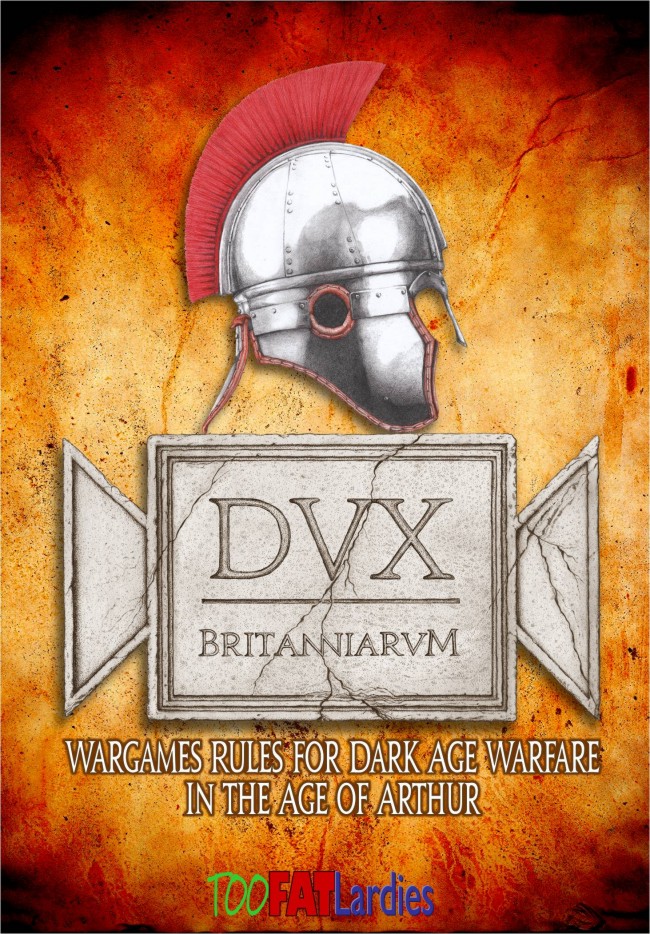
Dux Britanniarum is the latest addition to the Too Fat Lardies range.  The sub-title "Wargames Rules for Dark Age Warfare in the Age of Arthur" clearly places these in the early Dark Age period after the Romans had gone and when Britain was threatened by the Saxons.

Similar to their other recent publication - IABSM3 - this is a full colour perfect bound book accompanied by a set of printed cards (normal playing card size this time) and, in this case, an A3 colour map.  The rules are 92 pages which, following the introduction, are broken into five main sections, or "books".

Book One covers setting things up in four sections:

  • Setting Up Your Campaign
  • Selecting Your Kingdom
  • Assembling Your Forces
  • Creating Your Characters
The rules are intended to be driven by a simple to manage campaign system which provides a context for each game and an opportunity to develop your leader characters and forces.  This allows a variety of games to be played which have more meaningful objectives.  This is an approach I really like as it will avoid that "last two minutes of the superbowl" style play where everything is thrown in recklessly near the end of the game with no thought to the consequences!


Your initial force will contain a Lord, two other leaders, a champion and a number of units.  Units are Levy, Warriors or Elite troops (6 figures) or Harassing troops (4 figures with missile weapons).  Tabletop games can then affect the size and composition of your force, for example, cavalry may become available later in a campaign.  An initial British force will have one Elite unit, two warriors, three Levy and one of missile troops; whilst a Saxon raiding force will have two Elite, three warrior units and one of missile troops.

Book Two goes on to explain the campaign, development and the like in 7 sections:

  • Beginning Your Campaign
  • Career Paths
  • Filthy Lucre
  • Objectives
  • Force Deployment
  • Campaign Structure
  • Raids & Battles
Book Three then covers the actual tabletop rules, which have a number of similarities to other Lardies sets.  The rules are card driven (although with no equivalent of the "Tea Break" card - which means everything activates each turn).  They also have units receiving "shock" as a result of combat which can be removed by leader actions (IABSM, Sharp Practice, Through the Mud & the Blood).  They have a separate tactical card deck and also allow formations (like shieldwall) to be formed from multiple units (similar to Sharp Practice).  But these have been combined with enough specific elements to make these play differently from those other sets.

Each game is broken down into three phases, the first covers events before the game, the second the game itself and the third after the game.  Games may either be raids or battles - which operate slightly differently.

Phase One helps you set your initial morale level and the opportunity to prepare your men for the fight through speeches, drink, consulting the gods or having a single combat between each sides' champions.  Then the initial Fate Cards (tactical cards) are dealt.


The Fate Cards have three characteristics, they may have a suit (Saxon Boars or British Dragons or neither), they may be Pursuit or Retreat cards and they have their primary function as described by the main text.  Cards with suits may only be played when a leader is activated where as the ones without a suit may be played at any time; additionally they may provide bonuses to the player whose suit they belong to.  Cards with Pursuit or Retreat printed on them may be retained for use in the third, post game, phase.  The other cards generally provide a bonus to fighting, movement, activation or have an effect on your troops or your opponent's.

Phase Two covers the actual tabletop action.  As with some other Lardies' rules activation is driven by the main card deck.  Each leader and group of missile troops has a card in the deck.  When a leader's card is drawn they may activate a number of units or formations at a distance determined by their status (1-4) to move, join a formation or remove shock, or they can spend an initiative "buying" a card from the Fate Deck.  His troops then carry out their actions and a Fate Card may be played.  Once complete he may draw a further Fate Card (unless he has his maximum already) and then the next activation card is drawn.  Un-commanded troops may only activate after all the cards have been drawn; however, they cannot move into combat or join formations on their own.  One little wrinkle to this sequence is the Carpe Diem card which, if played, allows a player to play multiple Fate Cards at one time - which can be very useful - however, you still only get to replenish your hand one card per activation.


Movement is variable, usually 3D6, with modifiers for terrain, interpenetrating other units etc.  Combat is typically 1D6 per figure fighting to hit with a separate roll for effect.  Shock is accumulated as a combat result and ultimately will lead to the unit withdrawing unless removed by a leader.

The game is ended either by a force's morale collapsing or by them achieving their scenario objectives.

Phase Three, the post game part, allows you to resolve whether a withdrawing side will be pursued or can evade their pursuers - this is where those Pursuit and Retreat Fate Cards come in - which then affects the scale of the victory.  The the results of the game are calculated and the appropriate table consulted to see the effects - generally, how long it takes to recover losses, whether you get reinforcements and how much loot you may have got away with.  This then gives you options as to how you can develop your leaders, forces and the campaign as a whole.

The first three books are followed by The Book of Battles which contains the rules for terrain and scenario generation and The Book of Kingdoms which provides a map and brief background on the British Kingdoms of the time to allow you to anchor your campaign.


The rules are available in hard copy (£20), pdf and tablet-enabled pdf (with lots of easy to tap link buttons) for £15 each.  You can download and print the cards or buy the professionally produced set either separately for £8 on in combination with the rules.  The Lardies also sell starter armies for the rules containing figures from Gripping Beast.

As I was lucky enough to be one of the first 800 to ordered the rules I also received a 28mm "Arthur" figure:


All in all I think the production is very good with a nice graphical style, clear layout and the cards, in particular, are very pleasing.  I am hoping to get them to the table in a couple of weeks to try them out in anger and will report back on how they work in action.

Thursday, 19 July 2012

First Look: Pike & Shotte

Pike & Shotte is the latest addition to the Warlord rules stable and another of the "Black Powder family".  In this case the heritage is very obvious as this was apparently originally conceived as a supplement but ended up growing into a full set in its own right.

Pike & Shotte is intended to cover the 16th and 17th Centuries and since I have figures and have enjoyed reading Black Powder and Last Argument of Kings I thought I would pick up a copy.  Pike & Shotte is very like Black Powder both in terms of content and layout.  It is a full stand alone ruleset (which seems very much like Black Powder) but with background for the Italian Wars, Tudor Wars, Thirty Years' War, English Civil Wars and the Wars of the Sun King.  It's hardback with 208 pages and has the same attractive presentation style as Black Powder with lots of eye candy.

The book kicks off providing an overview of "the Age of Pike & Shotte" covering the core troop types and basic tactics.  The next 80-odd pages covers the basic and advanced rules followed by discrete sections on each of the Wars it covers.  These latter sections contain a brief overview, special rules and one or two scenarios along with appropriate army lists.  The book is rounded out by a two page quick reference sheet (which can also be downloaded from Warlord's website).

I haven't really given the Black Powder rules a decent try as yet (having only played a single game) and given the similarity of these I suspect these will play the same albeit with certain period specific aspects (pike for example!).  I'm not sure whether these will end up being my chosen rules for this period (only some more games will tell) but the book is beautifully presented and will nicely grace your bookcase shelf or indeed your coffee table.

Amazon have the rules available for £19.50 (which is where I picked up my copy) - although they do have the wrong cover picture for some reason (pre-production artwork?) - I've popped a link below if you're interested:

Wednesday, 18 July 2012

Dux Britannarium Available for Pre-Order

Too Fat Lardies have just announced that their new Dark Ages rules are now available to be pre-ordered.  The actual release date is slated to be 30 July.

The rules focus on the early Dark Age period (the Age of Arthur if you like) and are, as usual with the Lardies, card driven.  As with IABSM they will be selling professionally produced sets of cards to go with the rules (which will be normal playing card sized this time apparently).  The preview shots of the cards look rather nice and bundles of the rules and cards are available too.

People who pre-order can get hard copy and pdf along with the cards and the first 800 will get a limited edition "Arthur" figure too.

Richard Clark, the author, gives a good overview of the rules and, in particular, their easy to run campaign system on the latest Meeples & Miniatures podcast (episode 91).

Friday, 6 July 2012

First Look: John Company (Edition the Third)

Whilst looking around for a set of rules for larger Indian Mutiny games I came across John Company from The (Virtual) Armchair General.  A little research indicated that these might be suitable so I picked up a copy from Mutineer Miniatures along with a few additional packs for my next units.

John Company comes as a 196 page softback book with an optional graphics pack (which consists of colour versions of the back and white card and counter pages in the main book).  The colour covers contain back and white content in single column format with various tables, diagrams and contemporary illustrations.  The rules also come with 4 double sided quick reference sheets.

John Company is intended to cover all the campaigns of the Honourable East India Company from 1750 to 1860.  The smallest unit is an Infantry Battalion, Cavalry Regiment or Artillery Battery and the rules recommend a player for each Brigade (or roughly 50 figure bases).  The rules we written for 25mm miniatures with a ground scale of 1"=100' but are easily adapted to other scales.

The rules are card driven with Orders, Actions and Events decks.  Each turn you need to determine whether units are out of command (in which case they roll on the "Without Orders" to determine what actions they may have available).  The a card is drawn from the Orders deck for each General - you can then determine from the General's leadership rating how many orders he may give this turn.  Orders cards may also indicate that an Event has occurred, in which case a card is drawn from the Events deck.  Order counters are placed next to the relevant units.  There are 23 different orders which may be issued broken down into four classes - defensive, advancing, retiring and charge.  Certain orders are only available to certain unit types and some orders are "continuing" (i.e. they only need to be issued once).

Once orders have been placed those with charge orders will declare their charges and then these are resolved, with conflicting charges resolved in order of die rolls.  The remaining units in each Brigade need to wait until the Brigade's card has been drawn from the Action deck in order to activate and carry out their orders.

The rules make extensive use of the "resolve" test to determine what the units actually do within the context of their orders.  Each unit has an initial resolve level determined by their type.  Up to forty different modifiers can be applied to the initial resolve level, some positive but most negative, depending on the unit's condition and circumstances (some of the modifiers are dice rolls).  A table is then consulted cross referencing the resulting morale against the unit's order class and formation.  The results range from a bonus to movement through to rout.  This modified resolve is also used (after applying further modifiers) as the unit's fire factor which, compared to the numbers of basing firing, determines the result of small arms and artillery fire.


Melee can only occur in the event of a charge and once again the current resolve level is used.  Confrontation modifiers are applied and the units' resultant resolves compared.  This determines both the losses and the result of the close combat (if indeed the units come into contact).

There are sections on terrain, weather and optional rules for fatigue, artillery bombardment, sappers, confusion, night fighting and the like.  Army profiles are provided for the various combatants along with three introductory scenarios one each from the 1st Afghan War, 1st Sikh War and the Mutiny.  There are also designers notes, sections on figure sources, uniform guides and s list of battles fought by the HEIC.  The back of the book then has the pages of cards, counters, markers, templates etc.

The rules look interesting but the extensive use of modifiers may make them somewhat fiddly - only a tabletop game will determine that - but the approach makes them look like they should be good for solo play; however, the presentation of the rules could have really been improved.  I didn't really find the contents page layout as clear as it could have been.  The approach of embedding and explaining the modifiers within the main body of the rules does not help readability particularly when combined with the single column format and I'm sure having 4 "quick" reference sheets may not find favour with some.

Monday, 2 July 2012

WW2: Eviction Notice

Lieutenants Summers and Turnbull along with Sgt. Bunkum were faced with a problem.  Having only a few men they had to hold up a German attack supported by some armour!


Lt. Summers took a few men and took up a position in a cottage on the road.  He carefully concealed the bazooka team behind the bocage in a field to the rear.


Lt. Turnbull took the .30 cal and few men and occupied the house on the right but pushed a small group forward to cover the field adjacent to the road.


Whilst Sgt. Bunkum and the remaining men formed the reserve.

The German assault group entered the field, split into two teams and began to advance down the side of the crops.  They move cautiously until the reached the edge of the planting and peered around it.


They suddenly came under a hail of automatic fire from a US sub-machine gun, the lead man was hit and the others ducked back.  Meanwhile their other team was making good progress down the far side of the field.


On the other side of the road the other squad and their MG42 team advanced, reaching a hedge overlooking Lt. Summers' position.  They were spotted when they tried to push the LMG through the hedge and two of the men went down.  They were luckier with their next attempt and raked the garden wall with the MG42, hitting the Lieutenant.

With the wall being hammered with machine gun fire the other paratroopers weren't waiting around to be out flanked.  They dragged Summers behind the house and, picking him up rushed across a lane to the safety of a bocage rimmed field.  Predictable as ever the Germans flanked the US position and after throwing a couple of grenades in rushed it - only to find that the birds had flown.

On the other flank the Germans were pushing their way through the standing crops and then threw grenades towards the US position.  The US paratroopers were stunned but the Germans then rushed them and only one escaped back to Lt. Turnbull's position.


Germans couldn't advance against against the extra men and firepower.  And, on the other side of the field the other German team had been spotted from the house and came under heavy fire and were forced to withdraw after taking a couple of casualties.

At this point the German armour arrived.  The panzer clanked its way down the road right into sight of the US bazooka team.  Unfortunately the guy with the bazooka was a little jumpy and their first shot went wide (but wide enough for the tank crew not to have notice it).  They reloaded and had another go - a palpable hit but on the front armour - not enough to penetrate.  The tank's turret began to traverse their way so they threw themselves down behind the bocage bank just in time as the shot was short.


With both armour and infantry advancing on their position the team took the incapacitated Lt. Summers and withdrew to join up with Sgt. Bunkum.  The Germans took their position.


With further German reinforcements arriving the paratroopers withdrew but in the confusion two of the men were captured.

Sunday, 1 July 2012

First Look: Beneath the Lily Banners (2nd ed)

Having read through the first edition of Beneath the Lily Banners (BtLB) which I have had for quite some time, I thought they looked like an interesting proposition for my 15mm WSS project; however, a number of articles on the second edition indicated they were not only improved but were also clearer and better explained.  So based on that and a recommendation from Ray over at Don't Throw a 1, I decided to pick up a copy.

The rules are intended to cover the period 1660 to 1721 and can be used for either small engagements at 1:5 or larger ones at 1:40 ratios.  In the latter an 18 figure unit (3 x 6 figures) represents a battalion.

As I haven't played the first edition of BtLB properly I can't do a fair comparison between the two editions; however, the second edition is certainly thicker!  It's a full colour softback with around 117 pages (including some adverts), in a two column format.  The text is interspersed with various photos - mainly of lovely 28mm figures - some of which are annotated to explain the rules along with a few line drawings.


The rules are broken down into 11 sections, followed by some optional rules and events.  This is followed up by sections on the Great Northern War, Eastern Wars and King William's War providing various adjustments for those theatres.  A scenario, Steinbeke July 1692, follows along with sample armies, a painting guide, bibliography and roster sheets.  The rules also come with two separate double sided quick reference sheets (they aren't two copies of the same QRS).


The rules are well laid out and the explanations seem pretty clear.  The rules work on a simultaneous activation basis so placing orders is required.  You dice against the ability level of your commander (from Plodder to Gifted) to determine how many units you can order each turn; however, there is a mechanism to avoid being unable to order anything for more than a single turn.  The section on fighting in built up areas is a nice addition and something that is often skimped on in other rules and the random events provide a nice flavour (although these can be omitted if they're not your cup of tea).

Overall these are very nicely presented and look very interesting.  I am looking forward to actually trying them out on the table and see how they compare to Maurice.

Saturday, 30 June 2012

Highlanders

I thought I would post a couple of pictures of the first batch of Royalist Scots I have based up for my Montrose project.  The figures are Redoubt 28mm: